





Staffordshire red blue quarry tiles
Staffordshire Red Blue is a new addition to the Ketley clay quarry tile range, inspired by the iconic Dreadnought Tiles Red Blue roof tile — a colour long favoured on both new‑build and conservation projects across the UK.
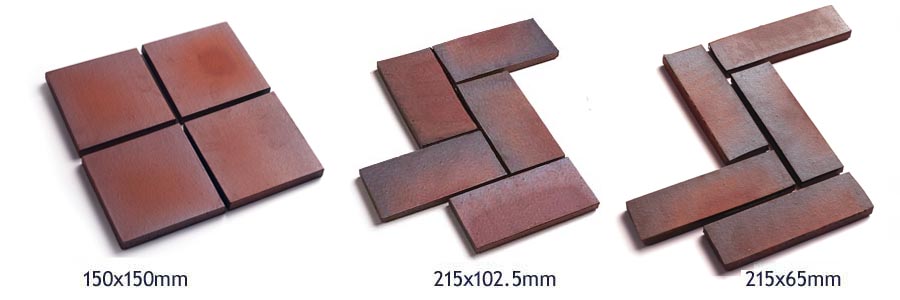
This distinctive finish is a natural, random blend of reds and terracottas merging with purples and blues. The variation is created through expert kiln firing, producing a rich spectrum of authentic clay tones. No two tiles are the same: some fire more blue, others more red, and many display the unique red‑blue fusion that defines this colourway.
The result is a characterful, heritage‑inspired finish with genuine depth and movement — ideal for designers and specifiers looking for a naturally varied, truly handcrafted aesthetic
 Frost resistant
Suitable for exterior & interior
 High slip resistance
Click here for more info
Category R11 C
Fittings
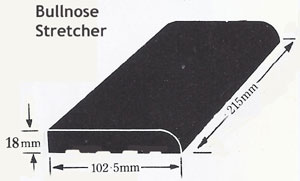
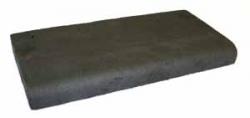
Quarry Tile Fittings
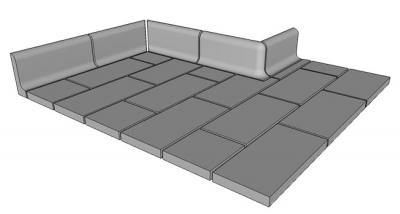
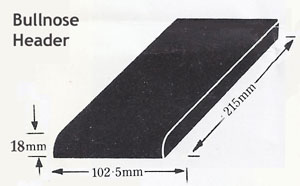
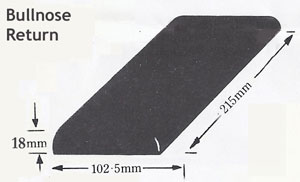
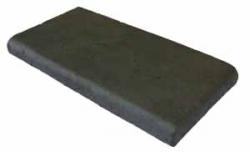
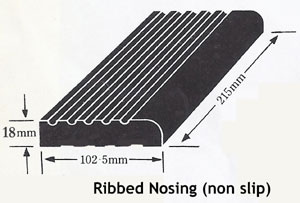
These products shown here match our rectangular quarry tiles 102mm x 215mm. Similar products are available to match our squares 100mm x 100mm and 150mm x 150mm. Please contact us for further details.
Bullnose Stretcher
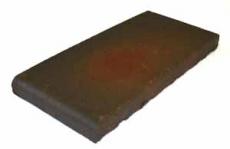
Bullnose Header
Bullnose Return
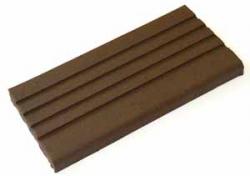
Ribbed Nosing
Environmental
Download third party verified Environmental Product Declaration (EPD)
Place of Manufacture: Brierley Hill, UK
Environmental Management: 14001 Download Certificate
Quality Management : 9001 Download Certificate
Download the Ketley Quality and Environmental Policy
Life Cycle: BRE Global Certification in accordance with EN 15804:2012 Download Certificate
Energy: Fired in gas kilns to 1130o C
Raw materials: Etruria Marl Clay from our own quarry in Cannock, 12 miles from our factory, and sand
Lifespan: Bricks are long life building product and Ketley's bricks are the toughest and most durable bricks you can buy.
Recyclability: Mortar can be cleaned off so the bricks can be reused. They can also be crushed and used as aggregate and/or as an inert bulk fill
Packaging: We keep packaging to a minimum using wooden pallets and we do not shrink wrap our brick packs.
Find out more about Ketley's approach to sustainability
Click for the Brick Development Association infographic on Sustainability of Brick
See below the latest video about Sustainability of Brick from the Brick Development Association
Tech Spec
Ketley Quarry Tiles for flooring
Standard: BS EN 14411:2012
Ketley Quarry Tiles are manufactured from the same clay, using the same processes as the Ketley 50mm and 65mm pavers and deliver the same technical characteristics of very low water absorption, very high strength and unrivalled frost resistance.
| Quarry Tile | Joint size | Coverage per m2 |
|---|---|---|
| 215x102mm | 10mm | 40 |
| 215x102mm | 6mm | 42 |
| 215x102mm | 5mm | 43 |
| 215x65mm | 10mm | 60 |
| 150x150mm | 10mm | 40 |
Packing On pallets - 1350 pieces on a pallet for 215x102mm size pallet weight (incl pallet) 1240kg
1100 pieces on a pallet for 150x150mm size pallet weight (incl pallet) 1010kg
1890 pieces on a pallet for 215x 65mm size pallet weight (incl pallet) 1155kg
Weight per unit 215x102mm size - 0.9kg 150x150mm size - 0.9kg 215x 65mm size 0.6kg
Download Ketley Quarry Tile Specification Sheet
Download Ketley Quarry Tile Specification clause as a word document
|
Properties |
BS EN 14411 Group A1b requirement |
Typical values for Ketley Quarry tiles |
| DIMENSIONS AND SURFACE QUALITY | ||
|
length x width
215mm x 102mm 215mm x 65mm
100mm x 100mm
150mm x 150mm
|
average tolerance +/-2% to an individual maximum of +/- 4mm
|
length 215mm+/-2.5mm
width 102.5mm+/-1.5mm |
|
Thickness (18mm)
|
average tolerance +/-10%
|
+/-1mm
|
|
Straightness of sides
|
within ± 0.6%
|
0.2%
|
|
Rectangularity
|
within ±1%
|
0.2%
|
|
Surface flatness
|
centre curvature ± 1.5%
|
centre curvature +/-1.5mm
|
|
edge curvature ± 1.5%
|
edge curvature +/- 1mm
|
|
|
warpage ± 1.5%
|
warpage +/- 1.5mm
|
|
|
PHYSICAL PROPERTIES |
||
|
Breaking strength
|
Min 1100N
|
2995N
|
|
Water absorption
|
0.5 < 3%
|
1.5%
|
|
Resistance to deep abrasion
|
Max 275mm³
|
106mm³
|
|
Frost resistance
|
Value to be stated
|
No damage after 100 cycles
|
|
Slip resistance
|
Pendulum test results exceeding 36 indicate low slip potential
|
Dry value av 96
Wet value av of 58
on Slider 55 for Staffs Blue
Dry value av 63
Wet value av of 55
on Slider 96 for Brown Brindle
|
|
Inclined platform in shod conditions |
Category R11 which indicates that they are considered not to be slippery in wet or greasy conditions.
|
|
|
Inclined platform in wet barefoot conditions
|
Category C which is the highest rating for slip resistance.
|
|
|
|
|
|
|
Bond strength
|
C2 Cementatious adhesives
|
>1.0 N/mm²
|
|
Reaction resin adhesives
|
>2.0N/mm²
|
|
|
Mortar
|
0.15N/mm²
|
|
|
Moisture expansion
|
No requirement
|
Negligible
|
|
Reaction to fire
|
Value to be stated
|
A1
|
|
CHEMICAL PROPERTIES
Resistance to staining
|
Minimum requirement 3
|
Paste stain 5
Chemical/oxydising stain 4
Film stain 3
|
|
Chemical Resistance
|
|
NPD
|
Laying
Laying Quarry tiles
Download our guide to laying and cleaning Quarry Tiles
Quarry tiles should be laid on a rigid base, with no voids underneath so that the load applied to them is transferred through to the base. In situations where heavy loads are involved, the strength of the installation can be improved by the use of a thicker paver as the transverse breaking load of a clay paving product is directly related to its thickness where all other factors are equal. It is advisable to select the material to resist the most arduous conditions likely to be imposed during the life of the product.
For a sand and cement base, allow at least 3 weeks before fixing the tiles. and for concrete, at least 6 weeks, preferably 12 weeks drying time should be allowed.
The surface should be hard, sound, clean, free from laitance and dust.
It should also be flat with a tolerance of ≤3 mm under a 2m straight edge. Any deviations from this should be corrected using a levelling compound.
Under Floor Heating
Ketley Quarry Tiles are fully compatible with both water‑based (wet) and electric (dry) underfloor heating systems. Their dense, extruded clay body provides excellent thermal conductivity and heat retention, making them suitable for internal floors where UFH is installed beneath a screed or adhesive bed.
Fixing
Ketley recommends using a tile adhesive such as ARDEX X 7 R. (Download Ardex guide to fixing Ketley Quarry Tiles) This adhesive is mixed with clean water and applied to the substrate with a suitably sized notched trowel to form straight, ribbed lines. The quarry tiles are then pressed firmly into the adhesive bed at consistent joint widths (6-10mm). The backs of the tiles should be regularly checked to ensure that solid bed fixing has been achieved.
Grouting
Board should be laid over the tiled area to spread the load of the tiler when carrying out the grouting operation. The grouting mortar should be adapted for the width of the joint with a lower ratio of cement for wider joints
Ketley recommends using a flexible grout which is available in a wide range of colours from companies like ARDEX. This product is mixed with clean water to a creamy consistency and worked thoroughly into the joints using a rubber squeegee. As the work proceeds, any excess grout should be removed, residues can be removed with a damp sponge for up to 30 minutes. Any dry film can be polished off with a clean cloth afterwards. If, after this process, there is a hazy mist on the surface of the tiles, this can easily be cleaned off with a grout remover, diluted according to the maufacturer’s instructions.
Movement Joints
These should be installed in accordance with BS 5385‑3:2007. Any existing movement/structural joints should be continued through to the surface of the tiling.
Cleaning
Cleaning and Maintenance
Download our guide to laying and cleaning Quarry Tiles
CLEANING & MAINTENANCE
Ketley Quarry Tiles require minimal routine maintenance. Floors can usually be kept clean by sweeping to remove loose dirt, followed by washing with warm water and a non‑soapy, neutral, sulphate‑free detergent. Clean, dry surfaces have a naturally low slip potential; most slip incidents occur when contaminants remain on the floor, so an effective cleaning regime is essential for both appearance and safety.
ESTABLISHING AN EFFECTIVE CLEANING REGIME
- Identify contaminants so the correct cleaning agent can be selected.
- Use suitable tools, with dedicated equipment for specific areas if required.
- Schedule regular cleaning, assigning responsibility and timing around pedestrian traffic.
- Provide clear instructions on procedures, detergent use, disposal, spill response, and record‑keeping.
- Inspect floors routinely to identify wear, damage, debris, or contamination.
CLEANING METHOD
Cleaning methods vary depending on contamination, surface profile, available agents, and whether mechanical equipment can be used. Regardless of method, all residues must be removed. After cleaning, rinse thoroughly with clean water and leave the floor dry. Failure to rinse can leave detergent or contaminant residues that emulsify when re‑wetted and increase slip risk.
INITIAL CLEAN AFTER INSTALLATION
Once grout joints have hardened, tiles may require a light clean using a neutral, non‑soapy, sulphate‑free detergent, followed by rinsing. Strong detergents should be avoided as they can cause scumming. Tiles should be pre‑dampened before applying any cleaner to prevent absorption into the tile body.
REMOVING DIFFICULT STAINS
- Abrasive cleaners, avoiding steel wool, which can leave metal particles that cause rust staining.
- Chemical cleaning using an appropriate solvent; specialist advice may be required for specific stains.
- Bleaching, where suitable, to remove the colour of the stain.
NB The use of sealers and polishers on quarry tiles can make regular cleaning more difficult.









-A.jpg)